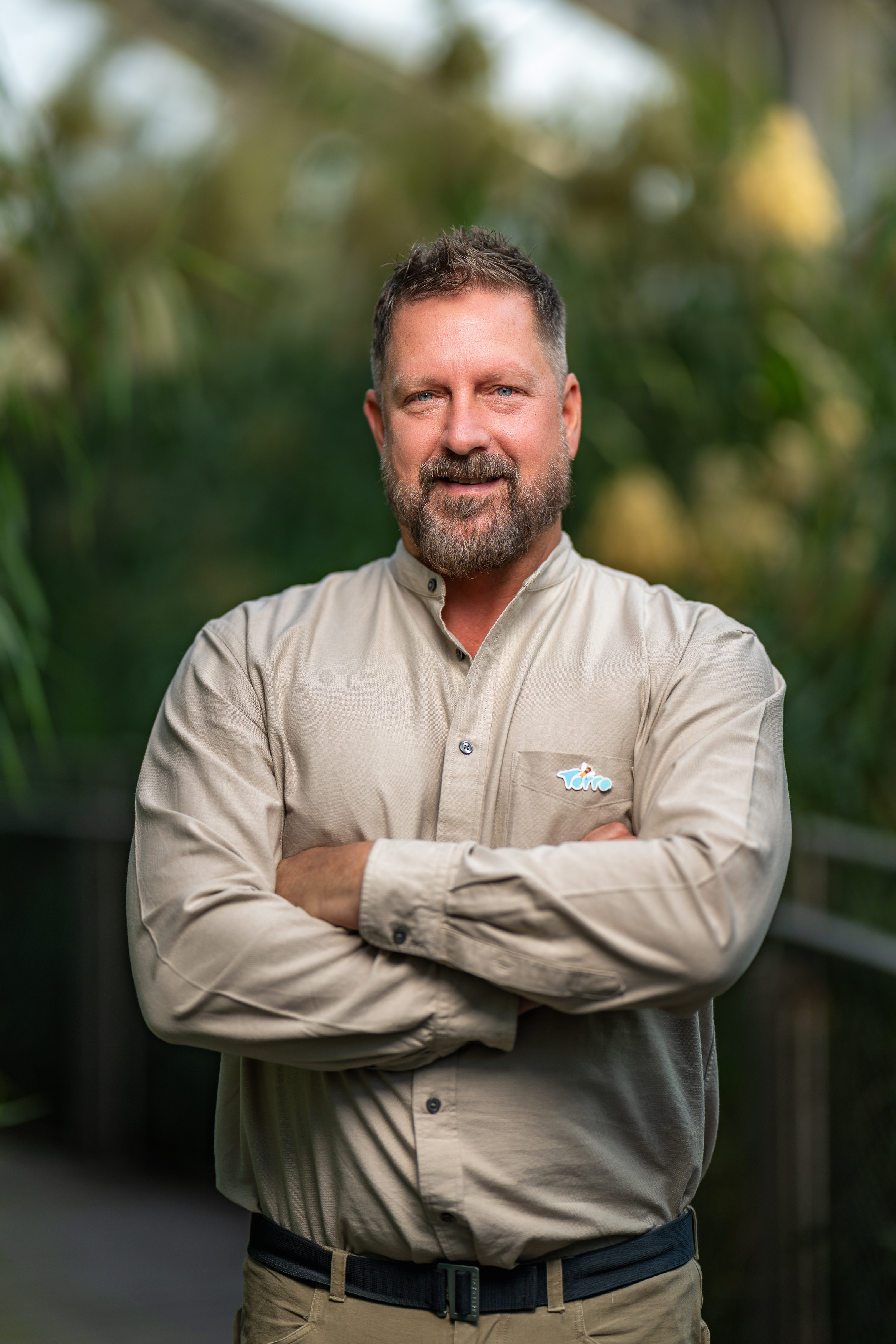
Terra doesn't just claim to be net zero, it's built to prove it, in a way visitors can actually see. The 8,000 square metre solar canopy above the building and the eighteen Energy Trees rotating around it aren't decoration. They're the reason Phillip Dunn, who leads sustainability education at Terra, told me the building works less like an exhibit and more like a classroom you can walk through.
A Fixed Canopy and Trees That Chase the Sun
The canopy above Terra doesn't move. It's a fixed array of solar panels covering roughly 8,000 square metres, generating around 10 megawatt-hours of electricity per day on average. That output shifts throughout the year, longer summer days bring more sunlight, but extreme heat actually makes solar panels less efficient. Dust is the bigger enemy in the UAE specifically, cutting performance by around 15 percent if the panels aren't cleaned regularly.
The Energy Trees work differently. Unlike the canopy, all eighteen rotate throughout the day, tracking the sun the way a sunflower does. They also use bifacial panels, capturing sunlight from above and light reflected off Terra's pale paving below. According to Dunn, the hardest engineering problem wasn't generating power, it was making the trees strong enough to carry that much panel while staying light enough to rotate smoothly. The answer was carbon fibre.
"Scientists are already exploring ways to replicate photosynthesis, the process plants use to turn sunlight into energy. One day, real trees may even inspire entirely new ways of producing clean energy."
Phillip Dunn, Terra
Why Rainwater Harvesting Isn't the Whole Answer in Dubai
Dubai's rainfall pattern doesn't suit large-scale rainwater harvesting the way it does in wetter climates: intense but rare, followed by long dry stretches. Terra does collect stormwater in a basement system for irrigation, but the more interesting experiment is smaller and stranger. The building's experimental Water Tree pulls around 20 litres of water a day from dew, though only on the small number of days each year when humidity and temperature align just right.
The more reliable model, Dunn told me, isn't mechanical at all. Native Tamarix trees on site collect dew on their needle-like leaves almost every morning, far more consistently than the engineered system. Understanding exactly how they do it is the kind of question that could shape future water-harvesting design, an approach called biomimicry, using nature's own solutions as the blueprint.
The Building as Classroom
I asked how Terra makes these systems legible to visitors, especially younger ones, beyond a wall panel explaining what something is. Dunn's answer was simple: come see it. Terra runs workshops and guided programmes that treat the building itself as the teaching tool, letting students encounter renewable energy, water systems, and biodiversity as things they can walk through rather than read about.
Most visitors, in Dunn's experience, haven't spent much time thinking about where their energy actually comes from or what using it costs. For a lot of people, sustainability starts and ends with switching off a light. A visit to Terra is meant to widen that picture, showing real systems that generate power, manage water, and work with the surrounding environment instead of against it.
The Part Most Visitors Miss
When I asked what's most overlooked at Terra, Dunn didn't hesitate.
"Without a doubt, the landscape. Most people come expecting an incredible building, but many don't realise that the gardens are just as innovative."
Phillip Dunn, Terra
That landscape includes a green roof grazed by goats, native honeybees living in the Jane Goodall Pollinator Garden, a freshwater stream modelled on the wadis of the Hajar Mountains, and more than 100 species of native and climate-adapted plants. An engineered wetland naturally treats up to 50,000 litres of wastewater a day. Solar hot water systems and passive cooling courtyards inspired by traditional Emirati barjeel architecture round out a landscape Dunn describes as a living laboratory, proof that nature isn't just something to protect around a building, it can be one of the building's teachers.
About Terra
Terra is the Sustainability Pavilion at Expo City Dubai, designed as a net zero energy and water building open for public and school visits.
Sources & Attribution
- All quotes and figures in this article were provided directly by Phillip Dunn, Senior Manager, Sustainability Education & Culture, Terra, in response to written questions from Greenly, August 2026.