Deforestation
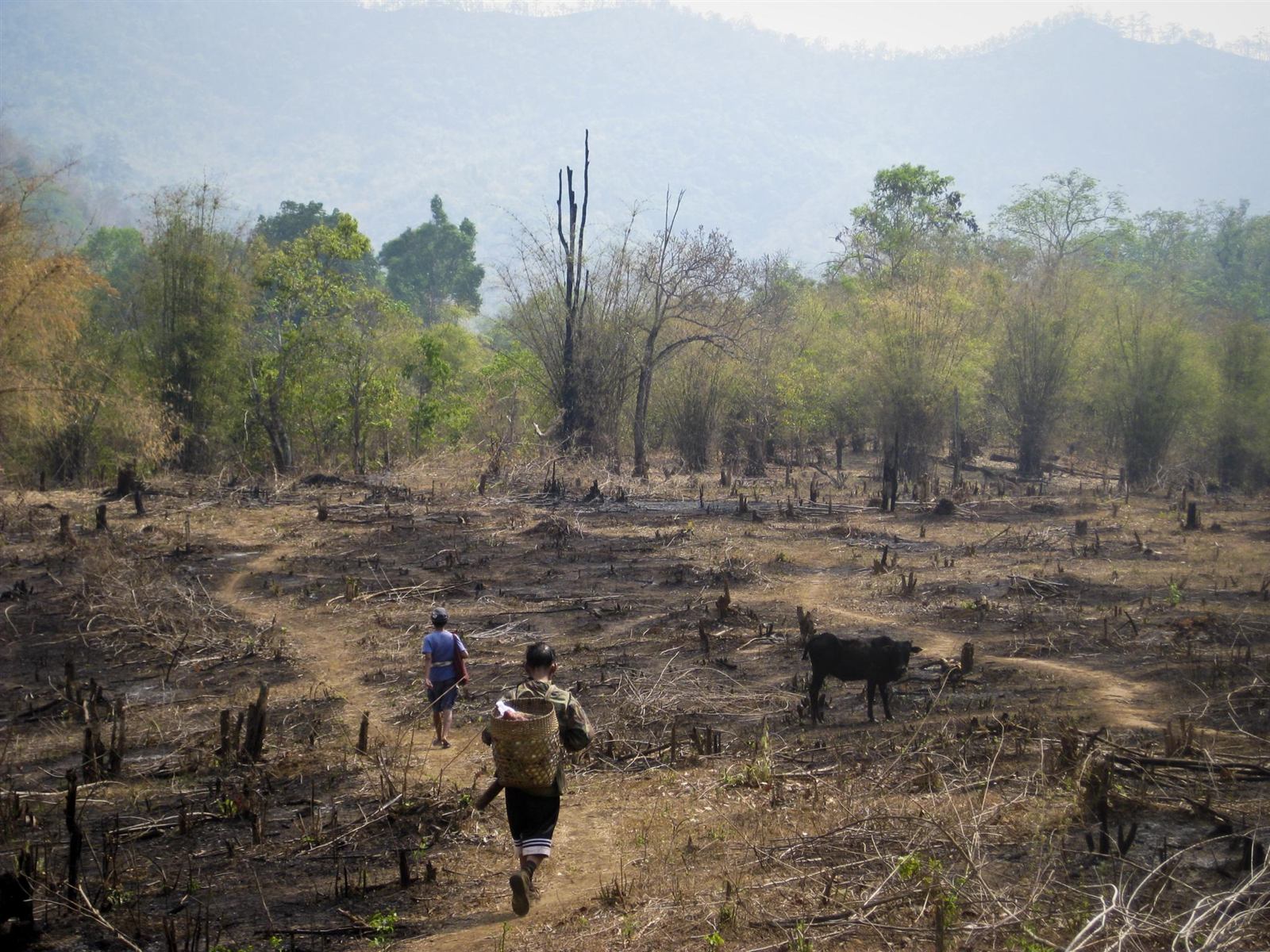
Every minute, the tropics lose an area of primary rainforest roughly equivalent to eleven football pitches. Most of it isn't burning by accident — it's being cleared, deliberately and predictably, for cattle and soy.
Tropical forests are disappearing at a pace that's easy to state in statistics and hard to actually picture. Global Forest Watch, which tracks forest loss using satellite data from the University of Maryland, recorded around 4.1 million hectares of primary tropical rainforest loss in 2022 alone — an area larger than Switzerland, gone in a single year. The Amazon accounts for the largest share of that loss, but the pattern repeats across the Congo Basin and Southeast Asia's remaining rainforests too.
The Amazon isn't just a large forest — it's a climate system in its own right. It generates a significant share of its own rainfall through a process called evapotranspiration, effectively recycling moisture across the basin and into agricultural regions of South America that depend on it. Scientists have warned for over a decade that clearing the forest past a certain threshold — some estimates put it between 20% and 25% total loss — could tip large sections of the remaining Amazon from rainforest into a drier savannah state. That shift, once triggered, would likely be irreversible on human timescales, releasing decades of stored carbon in the process.
Roughly 17% of the Amazon has already been cleared, and a further 17% degraded, according to estimates cited in a widely-discussed 2022 Nature analysis — placing the basin uncomfortably close to the lower end of that danger zone.
This isn't primarily about firewood or subsistence farming. Global Forest Watch and independent research consistently point to the same two drivers: cattle ranching and soy cultivation, much of the latter destined for animal feed rather than direct human consumption. Land is often cleared, used for a few years of grazing or a couple of soy harvests, then abandoned as degraded pasture — meaning a huge share of tropical deforestation trades a permanent carbon sink for short-lived, low-value land use.
The 2023 decline in Brazilian Amazon deforestation, reported by Brazil's National Institute for Space Research (INPE), is the clearest evidence yet that enforcement and political will can bend the curve quickly — deforestation rates there had risen sharply in the years before, then dropped once monitoring and penalties for illegal clearing were reinstated. It's a reminder that this crisis, unlike some others, responds directly and rapidly to policy choices, for better or worse.